Bidding Your First ICF Job: The Numbers That Make or Break the Estimate
Bidding Your First ICF Job: The Numbers That Make or Break the Estimate
📌 The short version: Experienced ICF crews land walls at a 3 to 5 percent premium over framed construction. First-timers who bid at experienced-crew productivity lose money, and first-timers who pad everything lose the job. The winning path is to price your actual learning curve on labor, protect yourself on the six commonly missed line items below, and capture the savings ICF hands back elsewhere in the schedule.
Most builders do not lose their first ICF job on block price. Block is a quote you can hold in your hand. They lose it on labor units they guessed, bracing they forgot to price, pump hours that ran long, and a waste factor they did not carry. This guide walks through the estimate the way a veteran ICF estimator builds it, with the field-validated numbers that separate a profitable first job from a tuition payment. Zero fluff.
Start with the wall, not the square footage
Framing estimators think in floor area. ICF estimators think in gross wall area, and every downstream quantity flows from it.
Gross wall area: total wall length times height, before openings.
Block count: gross area divided by the face area of your block, typically about 5.33 square feet for a standard 48 by 16 inch unit. Do not deduct small openings; the cut waste eats the deduction.
Concrete volume: for a 6 inch core, roughly one cubic yard per 65 square feet of wall; for an 8 inch core, roughly one yard per 48 square feet. Round up to the truck, not the yard.
Rebar: take it from the engineered schedule, then add laps and corners. On typical residential walls it lands near 0.75 to 1.0 pounds per square foot of wall.
💡 Pro Tip: Build a simple worksheet that starts with gross wall area, then auto-calculates block, concrete, and rebar. Consistent takeoff structure is your best defense against missed quantities.
Carry a waste factor of 1 to 3 percent on block for a clean rectangular plan, and 5 percent or more when the plan has angles, radius walls, or gable stacking. Good crews recycle cutoffs into the wall; first-time crews should assume they will not, yet.
Labor: price the crew you have, not the crew on the video
Published productivity for seasoned crews runs in the neighborhood of 1 to 2 labor hours per square meter of wall, which translates to a five-person crew stacking and pouring a typical house story in a week. Your first crew will not hit that, and the estimate has to say so out loud.
A realistic first-job model, validated across contractor interviews:
Phase Experienced crew First job, trained but new First course, layout, and leveling 0.5 day 1 to 1.5 days Stacking, rebar, and bucks per story 2 to 3 days 4 to 6 days Bracing and alignment 0.5 to 1 day 1.5 days Pour day, including prep and washout 1 day 1 day, larger standby crew Post-pour alignment and strip 0.5 day 1 day
💡 Pro Tip: Convert these durations into labor hours and a cost per square foot of wall. That number becomes your benchmark as the crew climbs the learning curve.
Two levers close that gap fast. First, put at least one experienced ICF lead on the wall, whether hired, subbed, or a paid manufacturer trainer, and treat the cost as insurance on the whole estimate. Second, spend real time on the first course.A level, square first course is the single highest-leverage hour on an ICF job; every course above it inherits its accuracy.
The six line items that sink first bids
From jobsite notes on real first jobs
Bracing and alignment systems. Rental or purchase, delivery both ways, and the weather or labor delays that were unexpected. Never assume the bracing rental rides free with the block.
Pump truck time. Boom pump operators and truck include day-rate minimums and travel. First pours tend to run slow because first timers get hesitant of blowouts. Price the extra hour into your budget instead of donating your money to a full day pump rate.
Bucks, embeds, and sleeves. Window and door bucks, anchor bolts, ledger connectors, utility sleeves. Small parts, real dollars.
Waste and remake. One to three percent block waste on simple plans, more with angles and gables, plus a blowout repair kit on standby.
Pour-day crew sizePour day needs hose hands, vibration, wall watchers, and a fixer. Budget the full standby crew.
Learning-curve contingency. A stated 5 to 10 percent labor contingency on job one. Shrink it to zero by job three, and win on speed.
Print this list and check the estimate against it before the number leaves your desk.
📌 Key Takeaway: These six lines rarely break a small budget individually, but together they can erase your entire margin on job one.
Where the money comes back
An honest ICF estimate also credits the other side of the ledger, and first-time bidders routinely forget their own savings:
Trades you delete: the finished wall already contains structure, sheathing, insulation, house wrap equivalent, and furring. No separate insulation sub, no wrap labor, no interior stud wall against foundation walls.
Schedule: wall systems go up in days and cure while you work elsewhere. Fewer weather delays, earlier dry-in, one less mobilization cycle.
HVAC downsizing: on design-build work, right-sizing equipment for a tight R-22+ envelope returns real dollars to the budget.
Callbacks: no drywall cracks from lumber shrinkage, no air-sealing punch list. Warranty reserve on the wall scope approaches zero.
"Priced this way, full ICF builds typically land 3 to 5 percent over framed for experienced crews, up to a 15 to 22 percent premium when every first-time inefficiency is absorbed and nothing is credited back."
Where your bid falls in that range is a choice you make line by line.
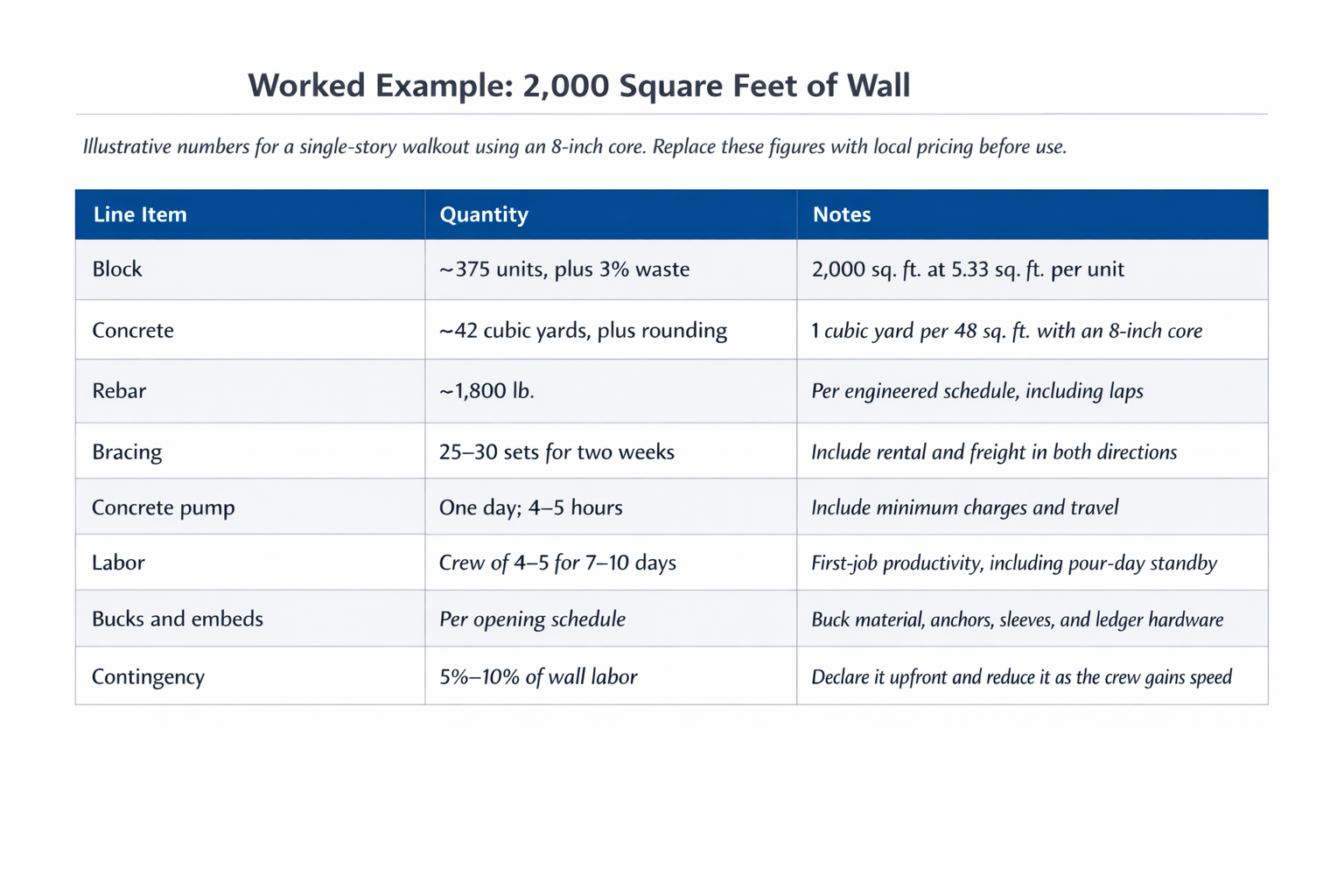
💡 Pro Tip: Keep this example as a checklist the first few times you price a wall. Even if your numbers differ, the structure keeps you from skipping a line.
Run the same job at experienced productivity and watch the labor line fall by a third. That delta is your margin growth curve over the next three jobs, and it is why crews that stick with ICF stop bidding against framers on price and start winning on schedule and performance.
Present the premium like a professional
When the owner sees a number above the framed quote, walk them through the operating math instead of apologizing: monthly energy near 3 cents per square foot instead of 10, insurance credits in wind and fire country, and a wall that does not generate maintenance. Owners do not buy foam and concrete. They buy the utility bill, the storm record, and the quiet. Builders who can tell that story convert the premium instead of discounting it. Our homeowner Learning Center exists partly so your clients arrive pre-educated; send them there before the budget meeting.
📌 Key Takeaway: Put numbers to comfort, resilience, and operating cost, then present them side by side with the framed option. The conversation shifts from “more expensive wall” to “better-performing building.”
Want a second set of eyes on your takeoff
ICF Near Me provides manufacturer-neutral project takeoffs, bracing rentals, and accessories support so your first ICF bid stands on real quantities.
Frequently asked questions
How much more does ICF cost to build than wood framing?
For experienced crews, completed walls typically carry a 3 to 5 percent whole-project premium. First projects that absorb every learning-curve cost can reach 15 to 22 percent, which is why labor planning is the heart of the first bid.
How much concrete does an ICF wall take?
Roughly one cubic yard per 65 square feet of wall with a 6 inch core, and one per 48 square feet with an 8 inch core. Always round up to truck increments.
What waste factor should I carry on ICF block?
1 to 3 percent on simple rectangular plans, 5 percent or more with angles, radius walls, or gable stacking. Experienced crews reduce this by recycling cutoffs into the field of the wall.
Do I need to rent bracing for an ICF job?
Yes, wall alignment bracing is mandatory for safety, straight walls, and pour-day access, and it is a real line item. Price the rental period, freight both ways, and standby days.
Should my first ICF bid include a contingency?
Yes, a declared 5 to 10 percent contingency on wall labor is honest and defensible on job one. Retire it as crew productivity climbs, typically by the third project.
More from the Best Practices™ series: ICF Corner Stacking, Reinforcement, and Pour Strategy and Vibration in ICF Walls: When It Helps and When It Hurts.
ICF Near Me is a manufacturer-neutral platform. Productivity and cost figures reflect published industry data and contractor interviews, not manufacturer brochures. Validate quantities against your engineered drawings and local pricing.


